
Yoga Does Harm
(and what to do about it)

I recently wrote about eating disorders and body dysmorphia. In that piece, I shared how yoga quite literally helped save my life. It was the doorway I found when I was desperate for relief, when I needed something steady enough to hold me through my own eating disorder.
What I did not have space to name then is something I am only now able to see clearly. The very same practice that helped me survive also reinforced a much older pattern, one that did not begin with me. A pattern shaped by systems of power that trained me, as a woman, to give my authority to something outside of myself.
Yoga was medicine for me. And yoga also caused harm.
I write this now as I wake up to another layer of truth in my ongoing healing journey. Not to discredit yoga, but to tell a fuller story. One that includes history, power, and the inherited ways women learn to distrust their own intelligence, their bodies, and their knowing.
This awakened moment of understanding comes from five straight days of deep, therapeutic meditative journeying. Meditative journeying. I have never typed or even spoken those words until this very moment, at least not that I can recall. To me, meditative journeying is the experience of having a plant medicine like journey without taking any medicine.
For reasons known and some unknown to me, I experienced five days of these meditations, where the inner landscape opened into a whole world of sensory imagery. I moved through parts work frameworks and was guided to replay past events in my life, surfacing with clarity and understanding about these past moments and behaviors.
The distilled version of what I saw, and what led me to this knowing about how yoga perpetuated my control mechanisms around food and body, goes like this.
.
I was taken into an experience of feeling my mother’s fear and seeing how that fear fueled her rage, and how that rage affected the household and my behaviors as a child. I chose to fawn and to be the perfect kid. I chose to aim to please and make the environment as comfortable as possible for her.
I thought, as a little one, that if all was calm in the environment, if I was well behaved, if I did not do anything wrong, then she would be chill, there would be no rage, everything would settle, and everyone could be happy. Her well being became my responsibility.
What I am beginning to understand is that my disordered eating was not only about food or body image. It was about power. It was about where I learned to place authority.
As a child, I learned that safety came from managing the environment. From being good. From being disciplined. From overriding my own needs in order to maintain peace. That same pattern had already been reinforced for generations before me. Women have been taught, again and again, that their worth and wisdom are not inherent. That guidance must come from outside. That obedience is safer than listening inward.
When you inherit a world that questions women’s intelligence, intuition, and embodied knowing, you learn to look elsewhere for direction. You learn to mistrust your own hunger. Your own desire. Your own signals. You learn that control is virtue and discipline is salvation.
This is the soil my eating disorder grew in.
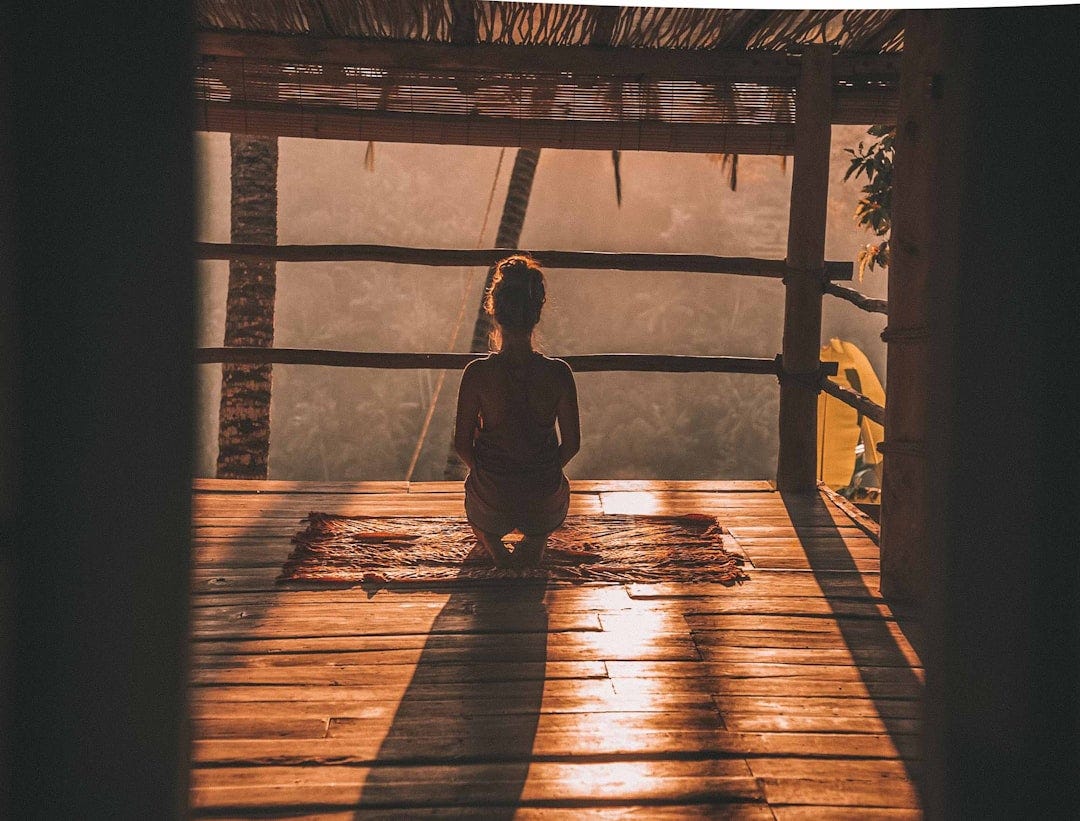
From there, I was shown the lineages of men who have passed down the knowledge of yoga, and how the yoga we know in the West is often steeped in language and practice aimed at dismissing the body, transcending the body, cleansing and purifying the body in order to ascend and arrive at a bliss state.
In order to arrive at nirvana, we must rid ourselves of the experiences of the body. Transcend. Ascend. Go higher and higher. The body is impure. Forget your desires. Forget your passions. Renounce all of that so you can touch the infinite.
Historically, many dominant strands of yoga philosophy, especially those shaped by monastic and ascetic traditions, emerged within social systems that valued renunciation, hierarchy, and obedience. These were systems where power lived outside the individual, not within them. Practices designed for renunciates were later universalized and taught to householders and laypeople without context, often divorcing yoga from its original relational and embodied roots.
Yoga scholar Georg Feuerstein notes that classical yoga developed largely within an ascetic culture that viewed the body as an obstacle to liberation rather than its vehicle.
And yet, this was never the whole story.
Even within yogic traditions themselves, there are counter currents. Tantra, Bhakti, and non dual Shaiva traditions taught something radically different. Liberation happens through the body, not away from it. Desire is not the enemy. Sensation, emotion, and embodied life are portals, not problems.
Still, the dominant narrative that reached the West leaned heavily toward control.
.
The deeply ingrained pattern of controlling my environment from childhood led directly to my control of food and exercise, and that ultimately led to my collapse.
The peace and space of a yoga class led me to teachings that affirmed, yes, control this body, purify it, cleanse it.
It was sneaky.
I could disguise my desire to be skinny by saying, “Hey, I found my path. It is this yogic path. It is helping me.” I felt better after savasana. I felt more at peace than I had in a long time. So I stayed. I practiced. I became the perfect student. I followed all the steps, because I was told that if I did, I would heal and all would be well.
I fit into the crowd. I could easily discipline myself. I could easily follow the protocol.
I could easily do this until I rebelled.
And I fucking love the inner rebel in me. Thank goodness for her. Thank goodness for your inner rebel. Thank goodness for these bodies and the inner wisdom that rises up from that deep well within.
That inner rebel in me is of the body. Through the body. A thread of understanding. A deep knowing voice that I can only dismiss for so long.
And the real training I have been in all these years has actually been learning to be more in my body. To embody. To listen. To stop dismissing the incredible genius that lives within me, and within you, right here, right now.
Alive in me. Alive in you.
This is inherent power.
And it is the power that has been questioned, shunned, and shamed for millennia, especially in women’s bodies.
As Meggan Watterson writes in The Gospel of Mary, “The soul does not need to be saved. It needs to be remembered.”
She also reminds us that authority is not something bestowed from outside. It is something remembered from within.
I appreciate Meggan Watterson so much! She makes it clear in her work on the Gospel of Mary, the suppression of women’s intelligence was not incidental. It was strategic. Early Jesus movements included women as teachers, healers, and spiritual authorities who taught from direct embodied knowing. Mary Magdalene was not marginalized because she was unimportant. She was marginalized because she was powerful.
In the Gospel of Mary, Peter questions her authority precisely because her wisdom does not come from hierarchy. It comes from experience. From the body. From direct relationship with truth. Meggan Watterson names this moment as one of the earliest recorded examples of systemic suppression of women’s spiritual intelligence.
When institutional religion formed, teachings that affirmed inner authority were deemed dangerous. God was moved outside the body. Wisdom was centralized. Obedience became holy. Women’s intelligence was reframed as unreliable, emotional, and in need of correction.
This pattern did not end with the church. It continued through cultural, spiritual, and even wellness systems. Yoga, as it was transmitted through ascetic and patriarchal lineages, absorbed this same logic. The body became something to purify. Desire something to conquer. Hunger something to discipline.
.
When you grow up in a world that teaches you to distrust your own knowing, practices that promise liberation through control can feel like salvation. They offer structure. They offer belonging. They offer relief. And they can quietly reinforce the very disconnection they claim to heal.
This is where my relationship with yoga and my relationship with food became intertwined.
I woke up to the syzygy of my relationship with yoga.
Yoga saved my life. Yoga is medicine. And Yoga also did harm.
It pulled me through some of the toughest times of my life and supported a cycle of self harm. It is rooted in traditions that, at certain historical moments, asked humans to transcend the body, often because embodied power threatens external control.
If everyone knew they were equally powerful, no one could rule over them.
So stories were rewritten. Mary was made a prostitute instead of an apostle. Women were burned at the stake. God was placed outside the body instead of within it.
And the story goes on, right into this very day.
Feel the intuitive nudge and question it.
Feel the inner no and doubt it.
Feel the lightness of a yes and wonder if it is silly.
.
My meditative journeys brought me to this conclusion. My eating disorder is personal and systemic. It is my story, and it is not just my story.
The systems we live under shape the lens through which we see ourselves.
These journeys continue to wake me up, to peel back layers. We can journey without medicine. We can journey with medicine. We can journey alone. We can journey together.
What matters is pausing. Going inward. Receiving support when we need it.
We need more people awakening to embodied truth. What it feels like in our cells when something is true for us, and not fucking questioning it.
This takes practice. It takes community. It takes being with others who are living their truth and trusting their hearts.
We need one another.
We are not meant to do this alone.
I know that in every cell of my body. And I believe you do too.
Whatever you need to do to uncover your own knowing, this knowing recognized across wisdom traditions, I want to support you.
Take the step.
Now.
Today.
Pause for 3 mins. Be more mindful of where you are spending your money. Acknowledge who and what you are giving your time, attention and resources to. Choose differently without beating yourself up from past actions.
One by one, let’s choose.
Thank you for being here. You are so so appreciated. ✨
With love, Heather
Thank you for for this, Heather. Your lens speaks to me. It's a long road to recognize and reprogram patriarchal systems and conditioning. I, too, experienced harm in the practice of yoga (it was always male teachers who injured me by "correcting" my form). Turning inward has allowed me to find perspective and leadership within myself, and to practice movement in ways that are only healing.
Heather - I bow in great reverence to the inward journey, to the exploration of human dynamics, and to the effort of understanding what one has been, what one is becoming, and how we stand in relation to it all. How we've come into being in the ways that we have. Call it healing, awakening, movement, searching, contemplation, light gathering, enlightenment, or simply moving through life in ways that are healthier than before.
Whatever name we give it, I bow in great reverence to the work of finding our own paths, our own lenses, and to the ways we support one another along the way. And I bow in great reverence to trusting your own intelligence, your own body, and the ways you come to know your inner self.
What I found most helpful is that you laid out your truth in the way you see it and what you came to see it in relation to - the lens. Mine is the mind in conflict, how can yoga be good and not good, expanded to the body and spirit.